

Most of us probably had some idea of the parent we thought we'd be.
Patient. Understanding. The sort of parent whose children could tell them anything.
Perhaps we were going to do some things differently from our own parents. Perhaps there were things from our childhood we absolutely wanted to recreate.
And then we actually had children.
Real children. With their own personalities, needs and opinions. Children who don't always want what we want, who push against boundaries and who somehow manage to ask us a question at precisely the moment we have absolutely nothing left to give.
You can start the day feeling a bit like Mary Poppins and end it feeling considerably more Cruella de Vil.
Not because you've undergone a dramatic personality change somewhere around teatime, but because our capacity isn't endless.
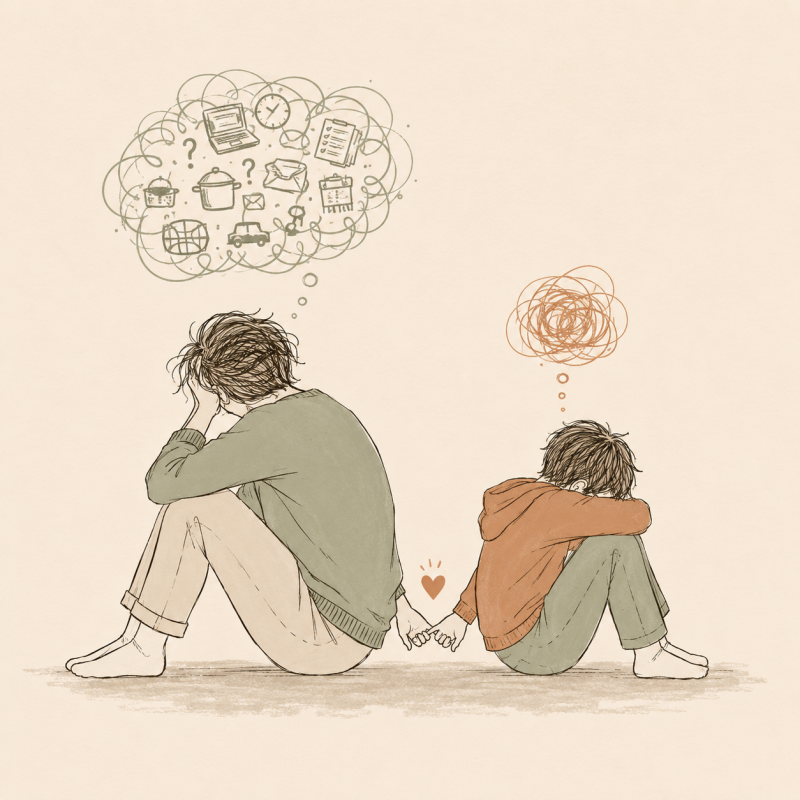
And sometimes, we don't particularly like the parent who shows up.
We hear ourselves nagging again. We react instead of responding. We lose our patience over something that, several hours later, doesn't seem nearly as important as it did at the time.
Sometimes we look at the way we're behaving and think:
This isn't who I wanted to be.
We bring our own childhood with us
None of us begins parenting with a completely blank slate.
We have a frame of reference.
Long before we have children of our own, we've already learned something about what families are supposed to look like. We learned it through the family we grew up in, the relationships around us and the things we experienced ourselves.
We may have learned:
- what happened when someone was angry
- how affection was shown - or wasn't
- what was expected of children
Some of those things we consciously take with us.
Others we deliberately leave behind.
And then there are the things we don't even realise we've carried until they suddenly appear.
You might hear yourself saying something your parent used to say and think, Where on earth did that come from? I hated it when that was said to me.
Our frame of reference isn't our destiny. But understanding it can help us recognise why certain situations trigger such strong reactions in us, or why some responses seem to appear almost automatically.
Parents are people too
There's an odd expectation attached to parenthood that once you have children, your own needs somehow become less important.
Of course, parenting involves sacrifice. Children need us, and sometimes their needs genuinely do have to come before ours.
But having children doesn't stop us being people.
We still need things.
Space. Rest. Autonomy.
We still have preferences, ambitions, relationships, work, worries and limits.
And there can be periods of parenting where it feels as though what we want simply doesn't matter.
Everyone needs something from us.
We're organising, remembering, listening. We're thinking about what needs doing next while still dealing with what needs doing now.
Eventually, something has to give.
Sometimes what gives is our patience.
The resentment nobody likes admitting to
Resentment is an uncomfortable word when we're talking about parenting.
Because admitting I'm resentful can very quickly become What kind of parent feels like that?
But there's an important difference between resenting your children and resenting what is being required of you.
You can adore your children and still resent never having any time to yourself.
You can be grateful for your family and still resent being the person everybody automatically turns to.
You can choose parenthood and still sometimes miss the freedom you had before it.
Two things can be true at the same time.
Pretending the second one isn't there doesn't make it disappear. Sometimes it just means it comes out somewhere else - as irritation, impatience or an argument about something that wasn't really the problem.
Reacting instead of responding
When we have enough emotional capacity, there's usually a little space between something happening and what we do next.
We can think.
What actually needs to happen here?
But when we're exhausted, overwhelmed or carrying too much, that space can become very small.
We react.
The voice gets louder. The words come out before we've properly thought about them. Something relatively minor becomes the final straw because it landed on top of everything else.
Understanding that matters.
But understanding why we behaved a certain way isn't the same as saying the behaviour was okay.
Sometimes we do get it wrong.
When you've got it wrong
There seems to be another impossible standard in parenting: not only should we get it right, but if we don't, we're supposed to feel terrible about it indefinitely as proof that we care.
Shame rarely helps us parent differently.
Responsibility can.
There is a difference between:
I'm a terrible parent.
and:
I didn't handle that well.
One attacks who we are.
The other gives us somewhere to go.
We can acknowledge what happened. We can apologise. We can try to understand what was happening for us at the time.
And, importantly, we can repair.
Rupture and repair
Relationships aren't built on never getting anything wrong.
There will be ruptures.
Parents get frustrated. Children get angry. We misunderstand each other, react defensively and occasionally handle situations in ways we'd quite like to rewind and have another go at.
We're human beings in relationships with other human beings. We're not robots.
What matters is what happens next.
Repair might be as simple as:
“I was frustrated, but I shouldn't have spoken to you like that. I'm sorry.”
No but you were...
No making the child responsible for our reaction.
Just ownership.
Repair doesn't erase what happened. It shows our children something important about relationships: people can get things wrong, take responsibility and reconnect.
That's something they'll need in their own relationships too.
What might need to change?
If you regularly don't like the parent you're being, telling yourself to be more patient probably isn't going to get you very far.
It might be more useful to get curious about what's underneath it.
Ask yourself:
- What am I carrying at the moment? Am I exhausted, stressed or overwhelmed?
- What am I not getting enough of? Time, support or space?
- What keeps triggering the same reaction in me? And does any of it connect with my own frame of reference?
Then there are the practical questions.
Where could a boundary change? What could somebody else take responsibility for? Is there something you're doing because you've convinced yourself a good parent should, rather than because your family actually needs it?
Sometimes something needs to change around us before something can change within us.
Before you go...
Not liking the parent you're being doesn't necessarily mean you need to try harder at parenting.
Sometimes it's an invitation to look at the person doing the parenting.
What have they learned? What are they carrying? What do they need?
And yes, sometimes we need to look at our behaviour and say, That wasn't okay. I want to do that differently.
We can take responsibility for that without deciding it tells us everything about who we are.
We will get it wrong sometimes. We will react when we wish we'd responded. There will be ruptures.
And there can be repair.
Perhaps instead of asking:
“Why am I such a bad parent?”
we could ask:
“What's happening for me that means I'm parenting like this right now - and what might need to change?”