

“Can you just—”
“No.”
You don’t even know what they were going to ask yet.
It could have been Can you pass me that cushion? It could have been Can you tell me if the kitchen is on fire?
Doesn’t matter.
The answer is no.
Because sometimes it feels as though everybody needs something from you.
Someone needs feeding. Someone needs a lift. Someone can’t find something that is almost certainly exactly where you told them it was. There’s a message you need to reply to, an appointment you need to remember, something you promised you’d sort out and a person you really should call back.
And then someone asks you a perfectly innocent question like, “Have we got any clean towels?”
And something inside you wants to scream:
I DON’T KNOW. WHY AM I IN CHARGE OF THE TOWELS?
It’s not really about the towels
Usually, it isn’t one enormous thing that gets us to this point.
It’s the accumulation of hundreds of tiny ones.
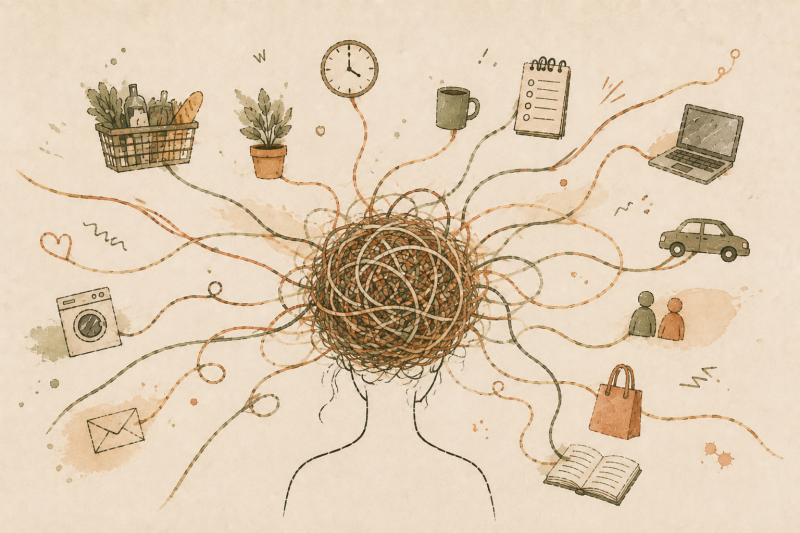
And many of them aren’t even things we’re physically doing. They’re things we’re holding in our heads.
Remembering that the toothpaste is nearly finished. Knowing there’s an appointment next Tuesday. Realising someone needs new shoes. Thinking about what everyone is going to eat later. Knowing which bill needs paying and when, whether there’s enough in the account to cover it, remembering the birthday present that needs buying, the form that needs filling in and the thing in the fridge that needs using before it goes off.
This is often called the mental load.
It’s the thinking, remembering, anticipating, organising and noticing that keeps everyday life moving.
But it isn’t simply a giant to-do list stored in your head.
There’s often another layer to it: anticipating what might go wrong.
If that bill comes out on Tuesday, will there be enough in the account? If the appointment is at three, who needs to be where beforehand? Have we got everything we need for tomorrow? What happens if plans change? Did I actually reply to that message, or did I just reply to it in my head?
You can find yourself constantly thinking a few steps ahead, quietly trying to prevent tomorrow’s problems while dealing with today’s.
It’s a bit like running a tiny risk-management department in your head.
Except nobody knows the department exists.
And because so much of this work happens internally, from the outside it can look as though you’re doing nothing at all.
You might be sitting on the sofa.
But your brain certainly isn’t.
“You only had to ask”
This can be where resentment starts creeping in.
Someone might genuinely believe they’re happy to help.
“Just tell me what needs doing.”
And sometimes that is helpful.
But sometimes you don’t want to be the person who has to know what needs doing.
Because noticing the washing basket is overflowing, deciding a wash needs putting on, asking someone to do it and remembering that something needs to be clean and dry for tomorrow is still managing the washing.
You haven’t handed over the responsibility.
You’ve delegated a task.
There’s a difference.
Sometimes what we desperately want isn’t another pair of hands waiting for instructions.
It’s for somebody else to notice.
When being needed starts to feel irritating
This bit can be difficult to admit.
Because these are often people we love.
So when someone asks you a completely reasonable question and you feel disproportionately irritated, or you hear your name for what feels like the 47th time that day and every cell in your body thinks please don’t need anything, guilt can arrive very quickly afterwards.
Why am I being like this?
They haven’t done anything wrong.
I’m horrible.
But irritation can be information.
Sometimes it’s your mind and body saying:
I have reached capacity.
It doesn’t necessarily mean the person asking is asking too much.
It might mean you’ve been giving too much, for too long, without enough opportunity to replenish yourself.
The fantasy of nobody needing you
Sometimes you don’t want a spa day.
You don’t want candles.
You don’t want somebody to tell you to practise gratitude.
You want to go into a room where absolutely nobody knows your name.
Nobody asks what’s for dinner.
Nobody needs a lift.
Nobody says, “While you’re up…”
Nobody even asks you where the scissors are.
And perhaps the most luxurious part of this imaginary existence is that you wouldn’t be responsible for anybody else’s experience of it.
You wouldn’t need to check everyone else was having a nice time before deciding whether you were allowed to have one too.
Wanting that doesn’t mean you want to abandon your life.
Sometimes it simply means you’d quite like a little bit of your life to belong only to you.
When caring becomes your role
For some of us, being the person who sorts things out didn’t begin recently.
Perhaps you’ve always been the capable one.
The listener.
The organiser.
The one people ring when something goes wrong.
There can be something lovely about being that person. Being trusted matters. Looking after people can be an important part of how we show love.
But roles have a habit of becoming expectations.
And when you’re very good at coping, people may stop wondering whether you are coping.
Sometimes we even stop wondering ourselves.
We just keep going.
Until a question about a towel nearly finishes us off.
You don’t have to earn rest
One of the traps we can fall into is believing we’re allowed to stop only when everything is finished.
I’ll sit down when I’ve done this.
I’ll have an evening to myself once I’ve sorted that.
I’ll relax when everyone else is okay.
The problem is that life doesn’t really become finished.
There will always be another wash.
Another message.
Another meal.
Another person who needs something.
So perhaps the question isn’t:
Have I done enough to deserve a break?
Perhaps it’s:
What do I need right now?
That can feel surprisingly uncomfortable when you’re used to directing that question towards everybody else.
Making some room for yourself
Reducing the mental load doesn’t necessarily require completely reorganising your life.
Sometimes it begins with noticing it.
What are you carrying that nobody else knows you’re carrying?
What are you constantly anticipating or trying to prevent?
What have you automatically taken responsibility for?
What could somebody else take ownership of - not simply “help” you with?
And what would happen if, occasionally, you weren’t immediately available?
Not everything needs an instant response.
Not every problem needs to become yours.
And sometimes somebody else can find the scissors.
Even if it takes them considerably longer.
Before you go…
There will probably always be people who need something from us.
That’s part of loving people and sharing our lives with them.
But you are a person within that life too.
You have needs, limits, moods and days when you simply don’t have much left to give.
Needing some quiet doesn’t make you uncaring.
Feeling irritated doesn’t make you unkind.
And wanting, occasionally, to hear absolutely nobody say your name doesn’t mean you love the people saying it any less.
Sometimes it just means you’ve spent so much time thinking about what everybody else needs that you’ve forgotten to ask one person.
What do I need?